Summary Development push includes schools, solarisation and targeted welfare programmes
PESHAWAR (Dunya News) – Khyber Pakhtunkhwa Chief Minister Muhammad Sohail Afridi on Friday presented a Rs2.122 trillion budget for the financial year 2026-27, outlining a fiscal plan that carries an estimated deficit of Rs48 billion while proposing a 7% increase in salaries and pensions of government employees along with a rise in the minimum monthly wage to Rs45,000.
The provincial budget projects total expenditure at Rs2.17 trillion against expected revenue of Rs2.122 trillion, reflecting a gap of Rs48 billion.
The Annual Development Programme (ADP) has been allocated Rs524 billion, forming a key pillar of the province’s development strategy for the upcoming fiscal year.
Budget overview
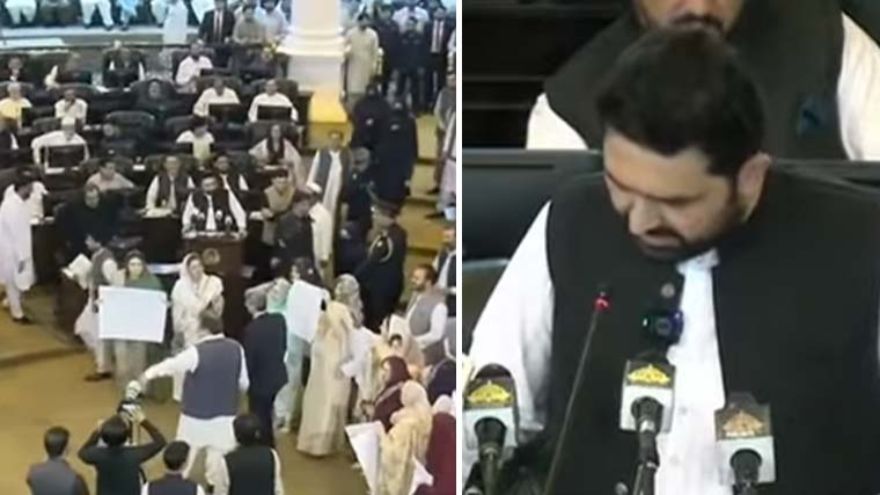
During his budget speech in the provincial assembly, Chief Minister Afridi stated that the government had set a revenue target of Rs2.122 trillion while expenditure was estimated at Rs2.17 trillion. He said the fiscal framework had been aligned with broader macroeconomic assumptions, including federal transfer expectations and provincial revenue generation capacity.
He also noted that Rs1.645 trillion has been earmarked for current expenditure, reflecting the bulk of recurring administrative and operational costs. External assistance and loans are projected at Rs150 billion, while Rs518 million has been proposed under the federal PSDP component.
Afridi further stated that the province’s share from federal receipts is projected at Rs1.59 trillion, while provincial receipts are estimated at Rs182.4 billion, forming the backbone of the overall revenue structure for FY2026-27.
Salaries, employment and social protection
The budget includes a 7% increase in salaries and pensions of government employees, alongside a proposal to raise the minimum monthly wage from Rs40,000 to Rs45,000, aimed at easing inflationary pressure on lower-income workers.
In the social protection framework, Rs15 billion has been allocated for the Ehsaas Mustahiq Programme, while Rs50 billion has been proposed for the Health Card initiative. The government has also set aside Rs28 billion for the Zakat programme, strengthening welfare support mechanisms across the province.
The Electric Bikes and Rickshaw Scheme has been allocated Rs2.5 billion, designed to promote affordable mobility and employment generation opportunities among youth and low-income groups.
Development and infrastructure projects
A significant portion of the budget has been directed towards infrastructure and development initiatives. The education sector has been allocated Rs468 billion, while health has received Rs334 billion, underlining continued investment in human capital.
For district governments, Rs52.8 billion has been proposed, while Rs29 billion has been allocated for merged tribal districts. Additionally, Rs52 billion has been set aside under the Accelerated Implementation Programme (AIP), targeting faster execution of development schemes in sensitive regions.
The government also reported that 7,952 new posts were created during the current fiscal year, while 1,100 public schools were converted to solar energy systems to reduce operational costs and improve energy sustainability.
Flood-affected populations received Rs4.29 billion in relief funds during the outgoing fiscal year, reflecting continued disaster response measures.
Sectoral allocations
Security and law and order have been allocated Rs191 billion, highlighting the province’s focus on stability. The MTI hospital system will receive Rs80 billion, while Rs36 billion has been earmarked for rehabilitation programmes.
Transport infrastructure continues to receive attention, with Rs7.5 billion proposed for the Peshawar Bus Rapid Transit system and Rs14 billion allocated for the transport department. The Khushal Hazara Programme has been assigned Rs4 billion to support regional development.
Agriculture and energy sectors have been allocated Rs29 billion and Rs42 billion respectively, while Rs90 billion has been proposed for local government institutions. The Home Department is set to receive Rs29 billion, reinforcing administrative and security frameworks at the provincial level.
Support programmes also include Rs2 billion for the Ehsaas Kisan initiative and another Rs2 billion for interest-free loans targeting overseas employment seekers. Meanwhile, Rs51 million has been allocated for the self-reliance of minority communities.
Chief Minister Afridi said the budget prioritises public welfare, education, healthcare, employment generation and sustainable development, with a focus on long-term provincial growth and improved service delivery across all sectors.